
HARP STRING INSTALLATION GUIDE
If the string won’t stay in tune it is a loose peg caused by the wood drying out a bit making the peg hole slightly bigger. Back the string off a bit. Push in very hard when tuning it.
If you are changing out the whole set we recommend you change one string at a time. Start with the longest string and bring up to one whole note below pitch. Continue until all of them are in and stable at below pitch then start bringing them up to pitch. Happy Tuning!
Monofilament Nylon Harp String: Tying the Harp Knot
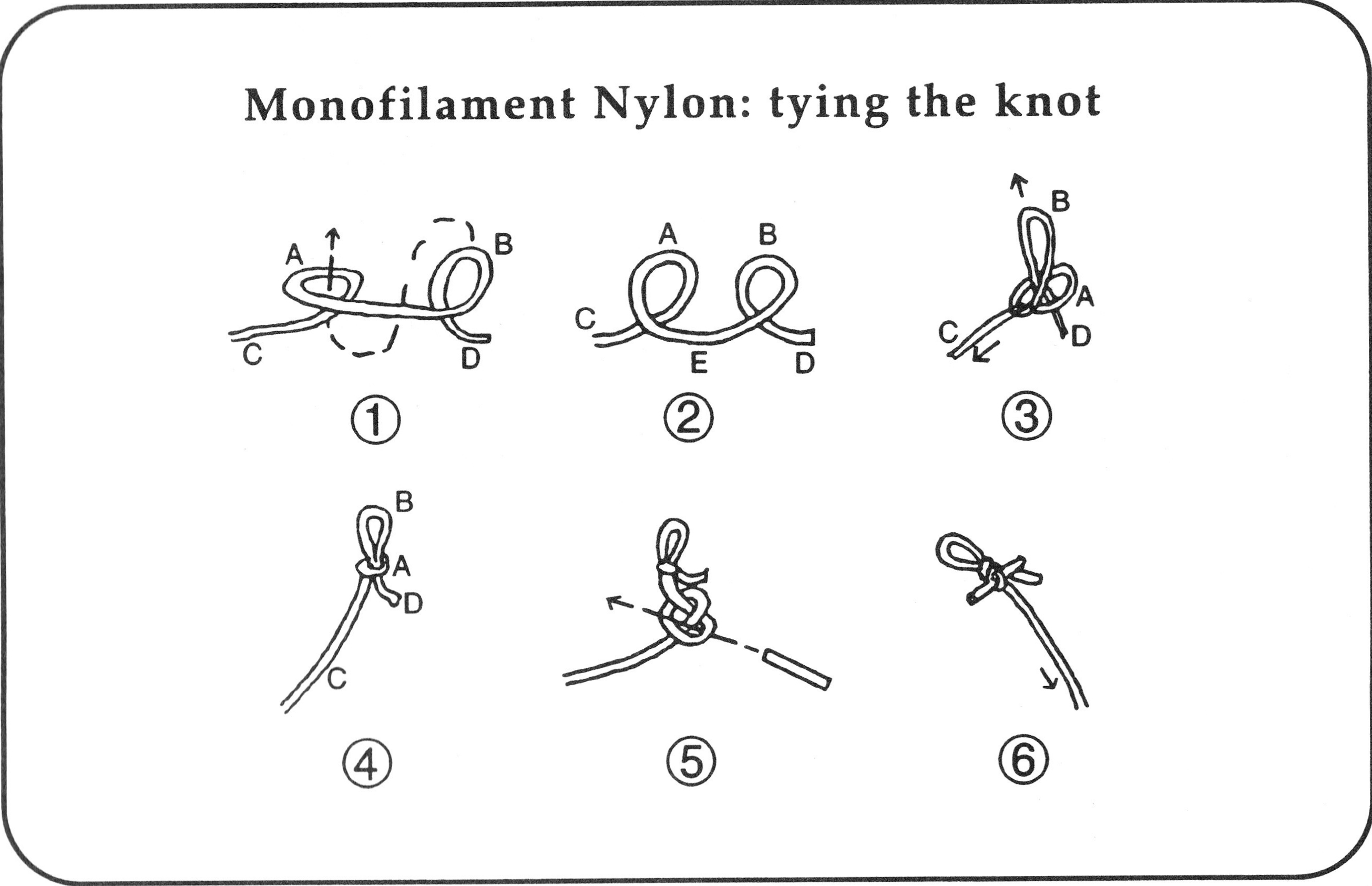
Our Harp String Installation Guide is essential because learning to tie the harp string knot is something that you need to do. It may look complicated, but it’s not. Follow the instructions and practice. Start with a piece of .032 or something light. Refer to the diagram labeled “Monofilament Nylon – Tying the knot.”
Figure 1
Here we are taking the end of the harp string, and making two loops in it. The very end of the string is “Y.” The long part of the string is “C.” With thumb and index finger of your left hand, form loop “A”. Use thumb and index finger of each hand to hold their respective loops while you peer back at the instructions here. Note that each of the loops goes behind section “E”. This is important.
Figure 2
Loop “A” is in your left hand. Turn your wrist so that loop “A” is horizontal. Leave loop “B” (in your right hand) vertical. As shown in Figure 2, move loop “B” below, and the up through, loop “A”. Grasp both loops now with your right thumb and index. Use your left hand to pull on the long length of the string(“C”). Use your right thumbnail to prevent the loop assembly from being pulled apart. As you pull on string length “C”, loop “A” will tighten around loop “B”, forming a harp knot. Make sure there is sufficient tail (Y), or else the knot will unravel. You now have a normal harp string knot.
This works fine if using a leather washer, or if your harp has small grommets. But many makers use large grommets, which require a toggle to be inserted through the harp string knot to prevent the knot from being pulled through the soundboard.
The best way to do this is to make a loop that goes back through itself as shown in Figure 5. Place the toggle midway through this loop, and tighten the loop by lulling on the string while your right thumbnail is lodged against this knot. Finally, hold onto the toggle only with your right hand while you pull the string with your left. This should snug it up nicely, and you have a slip-less harp knot that can’t be pulled through the soundboard. In the thicker string sizes string material is so stiff. In this case, you can stop at Figure 4 and slide a leather washer onto the string.
Installing the Monofilament Harp String on Your Harp
It is not the hole in the tuning pin that holds the string in place on the pin.
It is the friction of the string coils on the pin itself. The hole is just a convenient way of getting the string started around the tuning pin. Older instruments, like Harpsichords, didn’t have holes in the tuning pins.
Take the appropriate harp string, and tie a harp knot in it, as described previously. Place your hand, holding the unknotted end of the string, into the interior of your harp through the access hole that is in the back of the instrument. Feed the string up through the appropriate grommet, and grasp it with your other hand.
(Note: some harp makers use access holes intended for midgets, and feeding the string up can be a trial. In this case, consider feeding the string down through the grommet and then tying the knot.)
Now pull on the long end of the harp string, seating the knot a (and possible toggle or washer) against the lower side of the soundboard.
NOW: your natural urge at this point is to pull the string tight as you can through the hole in the tuning pin and start cranking to pitch. Don’t do it. This is an excellent way to break the string, because the edges of the tuning pin hole will act like a wire cutter.
We need to make coils around the tuning pin before any stress is placed on the string-to-tuning pin hole connection.
Place the loose end of the harp string through the tuning pin hole loosely, so there is some slack in the string, between tuning pin and soundboard. If you are holding the tuning key in your right hand, then use your left hand to control the slack and guide the harp string into making nice, neat coils on the tuning pin. With practice, you will be able to guess how much slack is required to get 3 coils on the pin when the string hits pitch. That is the ideal. Thinner harp string diameters might need more than 3. The thicker sizes might need just 2. If the excess harp string that protrudes through the tuning pin hole should get trapped under the coils on the tuning pin, then so much the better.
When looking at the tuning pin from the end that receives the tuning key, then traditional pin rotation is clockwise to tighten. As the harp string becomes taut, guide it into the groove of the bridge pin, and make sure it doesn’t get snagged on the sharping lever (if any).
Once the harp string is tensioned enough to stay in place on its own (though not necessarily up to pitch), clip off the excess harp string protruding through the tuning pin hole. If there is a lot of it left, coil if up and put it back in the package.
String life will be enhanced if you bring it up to pitch SLOWLY. When you do pitch the harp string, you can help it stay at pitch by manually stretching it some -just don’t do it too hard. A new harp string will not want to stay in tune. So just stretch, tune, stretch, tune, get those knees up! If you say enough Bad Words, the harp string will eventually stay in tune.
Installing Wound Nylon Harp Strings
The good news is that you don’t need to tie a knot in the end. It is already there, with leather washer. The bad news is that you can only cut the core of this type of harp string. You cannot cut the wrap. It will ruin the harp string. This is why we get so buggy about the proper vibrating lengths for wound nylons when you order. We have to make them right in the first place, because they can’t be altered later.
But you shouldn’t have to worry about cutting the wrap, because we have made them just the right length and we never, never make a mistake. No, really, come on, it’s true. Really.
First, if you haven’t read the section on installing monofilament harp strings do so now, because the same principles apply, and installing this type of harp string is very similar.
Place the core end of the harp string -the end without the knot and washer- up through the soundboard grommet, and place the end through the tuning pin hole. Leave some slack, so that we end up with 2-3 coils on the pin when the harp string is pitched. (With heavier sizes like .055/.025, 1-2 coils is okay.)
Take up the slack onto the tuning pin, guiding with one hand as you would a monofilament harp string. When the slack is gone, seat in the bridge pin groove, and bring the harp string up to pitch slowly, even more so than you did with the monos. When the harp string is up to pitch, then snip off the excess. Don’t cut right against the pin. Leave about 1/4″.
As you are bringing the harp string up to pitch, if the end of the wrap hangs on the bridge pin, then help it over the pin. You should know that where the wrap ends is the weakest point of a wound nylon harp string, and we don’t want to stress this area any more than we have to. You’ll notice that the harp string may appear too short when you first put it on the harp. This results from our string machine stretching the core so much prior to winding. When removed from the machine, it shrinks somewhat. But once the harp string is installed on the harp and up to pitch, it will stretch to its original length. There should be no problem with it being too short.
There is a lot of leeway as to where the wrap should stop on a wound nylon string. Cosmetically, it looks best when the wrap stops exactly halfway between the bridge pin and tuning pin. Strength-wise, it is best when the wrap winds around the tuning pin for about one coil or so -remember that weak point where the wrap ends. But it is no big deal. The wrap could actually stop about an inch before the bridge pin and the string will still sound fine.
Installing sfb, sfn, bfb or bfn harp strings
These are bass harp strings, with a steel or bronze core. Nylon stretches a lot. Metal doesn’t. So, it is imperative that you have a lot of slack in the string before you start bringing it up to pitch. There should be about a minimum of 3 coils on the tuning pin when the string is at pitch.
Thread the core end of the harp string up through the soundboard., and through the hole in the tuning pin. Leave plenty of slack. Slowly start winding the tuning pin, guiding the slack onto the tuning pin in nice neat coils. If the excess core sticking out the other side of the tuning pin hole gets trapped under the coils, that’s just fine, and will help anchor the harp string that much better.